Google confirms its Android smartphones infected with a Security Backdoor

Google recently has confirmed the presence of a pre-installed malware in a number of its android devices back in 2017. The malware which had already infected the phones even before they were shipped. The malware belongs to the “Triada family” and is termed as one of the “most dangerous trojan” of the world.

As Google described, in their lengthy original blog about the malware, the Triada malware was identified by Dr. Web back in 2017, when they named a few devices infected with the malware including the “Leagoo M5 Plus, Leagoo M8, Nomu S10, and Nomu S20”. It’s rare that anyone of you is using these devices, but the dangerous part in this is that Google itself hasn’t yet declared any detailed list of the devices. Moreover the hackers were identified to be frequently using Chinese language with the vendor name “Yehuo” or “Blazefire.”


The Triada malware wasn’t used by Google anyhow, but was found factory-installed in its products laid a question mark on Google’s image and the security of its products. Triada had got a way to virtually factory-install the malware before the customer could actually open the box. The incident can also be termed as a brilliant yet dangerous case study of how modern hackers are persistent, clever and patient enough to breach the security of such big tech giants, and how adept they have become in the past years.

Now the main question arises, whose mistake was that? Well, Google made it clear that the OEMs weren’t directly responsible for that. In fact, all the OEMs don’t have the resources necessary to build everything they want to use in-house, so they rely on third party vendors. Those third party-vendors can be an easier target than any other tech giant.
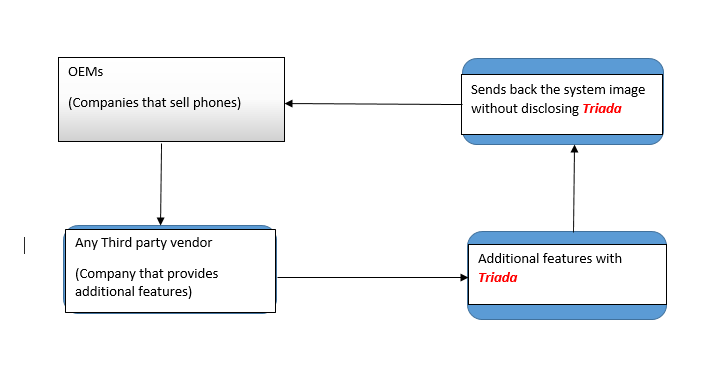
But, Google clarifies that the same target can be used to de-infect all the devices via OTA updates, and promises a quick update to the virus. Google also enforces on having Google play services on all smartphones so as to readily check for potential security breaches.
PCs vs Mobile phones: The collapsing differences

Not a decade ago, Laptop and Desktop sales were on a high rise with companies like Microsoft totally depending on the sales of its PC operating system Windows, but the bubble blew out in 2012 with the PC market saturation, when for the first time in the 21th century, PC shipments  started to fall.  Economists are expecting a continuing decline in the coming days too. But what changed in just a decade? Why are lesser people buying PCs. A major reason for that can be accounted for the increasing use of smartphones.

In 2008, Steve Jobs changed the world with the introduction of the iphone. People were introduced to a device that could do their basic day-to-day tasks without their hectic to turn-on and off their PCs. As he said,


“An ipod, a phone and an internet communicator.”

Steve Jobs

The quote used by Steve Jobs while introducing the iphone to the world, the revolutionary device. Though the device doesn’t seem a breakthrough comparing to the present day smartphones, but it was a revolutionary thing in 2008. The situation was more graved by the introduction of android by Google Inc. and the first android device HTC Dream, also known as the T-Mobile G1. Since then, android and iPhone hardware have continued to be better than ever.

In 2017, Qualcomm Snapdragon, a leading manufacturer of android processors, tried to extend their wings with their then latest flagship processor, the Snapdragon 835 by embedding it into a PC. This led to the first always-on PC of the world. Though the experiment didn’t prove to be even called a success, it was at far a great idea, and we again saw Snapdragon trying again with their Snapdragon 850, which was specially designed for PCs in 2018. But mobile processors didn’t ever take a lead in PC market due to having a totally different architecture causing most of the apps not running on them.


The PCs generally use the Intel Core processors that are built on x86 architecture while Snapdragon processors run on ARM Cortex.


This creates a huge difference between them. Smartphone processors cannot handle a heavy operating systems like Windows. That’s why the Snapdragon 835 couldn’t be successful. Also, the PC apps needed to be rewritten to work with ARM based processors.

Today, PCs are emerging as a way for professionals, while smartphones are taking their place in the stock consumer markets. PCs are radicalizing work environments in offices, Government offices, Companies, Gaming, Animations, Photo editing, Coding, that are still beyond the smartphone niche. Though smartphones have surpassed PCs in the communication sector, and in the past year smartphone browsing has outnumbered PC browsing user base, we see that PC browsers are far more feature rich than smartphone browser available so far, but those features are only used by the professionals and learners. Smartphones have more diverse apps, free apps and are more handy than any PC so far.

The Final Conclusion

PCs are changed the way they were used a decade ago, they have grown smarter, faster and notably more professional. Smartphone on the other hand is a user friendly device that is used by masses for their simple day-to-day tasks and as a communication device, setting alarms, reminders, browsing, etc. It may be in the future that some new smartphone technology overtakes PCs, but, that seems quite far.